
Volar plate injury
Understanding the injury
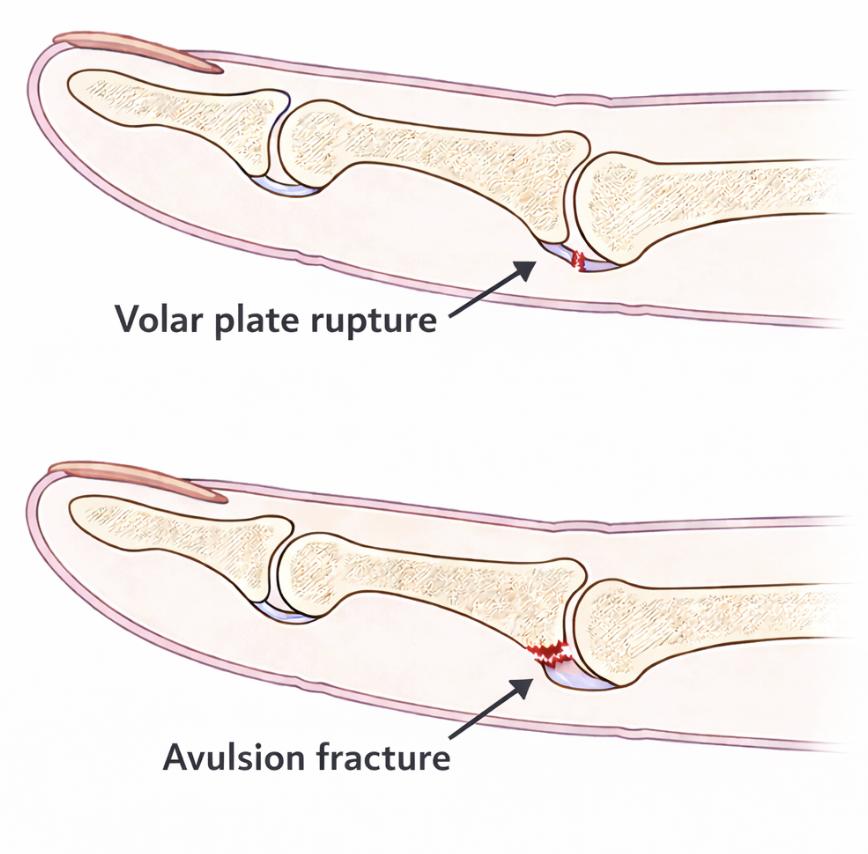
A volar plate injury occurs when your finger is forcefully hyperextended (bent backwards beyond its normal range). This mechanism can tear or avulse (detach) the volar plate - a thick ligamentous structure on the palm side of your finger joint that prevents excessive hyperextension.
The proximal interphalangeal (PIP) joint - your finger's middle knuckle - is most commonly affected. These injuries typically result from sporting activities or falls and represent a frequent finger injury pattern.
Treatment focuses on controlled mobilisation and protective support to allow healing while preventing stiffness.
-
Pain, swelling, and bruising are expected. Continue moving your finger within comfortable limits - gentle motion aids recovery. Avoid hyperextension of the joint for 2 - 3 weeks, especially if the finger joint dislocated at the time of injury, as this can disrupt the healing process.
Over-the-counter analgesics can be taken as needed for pain control.
To minimise swelling and discomfort:
Rest: during the first few days, avoid activities that significantly increase your pain level.
Ice: apply ice packs wrapped in a towel for up to 20 minutes every 1-2 hours. Continue this regimen for up to one week.
Elevation: keep your hand elevated above elbow level for up to two weeks when resting.
You may receive a tubular support splint (Bedford splint) to wear for up to three weeks, providing gentle compression and protection.
-
Use your hand for normal daily activities while avoiding heavy lifting or gripping
Do not force your finger into hyperextension
Practice making a complete fist frequently to prevent joint stiffness
Perform the prescribed exercises regularly
Return to contact sports is generally appropriate around 8 - 12 weeks post-injury.
-
Most volar plate injuries heal well with conservative management. However, if you develop progressive stiffness or difficulty straightening your finger (volar plate contracture), further assessment will be required.
In cases where the joint shows instability or malalignment, additional treatment including specialised splinting or occasionally surgical stabilisation may be necessary.
Exercise program
Perform these exercises several times daily to maintain finger mobility:
Volar plate injuries are common and typically heal well with appropriate early care and exercises. If you have concerns about your recovery or develop worsening symptoms, please seek further medical assessment.