
Thumb sprains
Understanding thumb ligament injuries
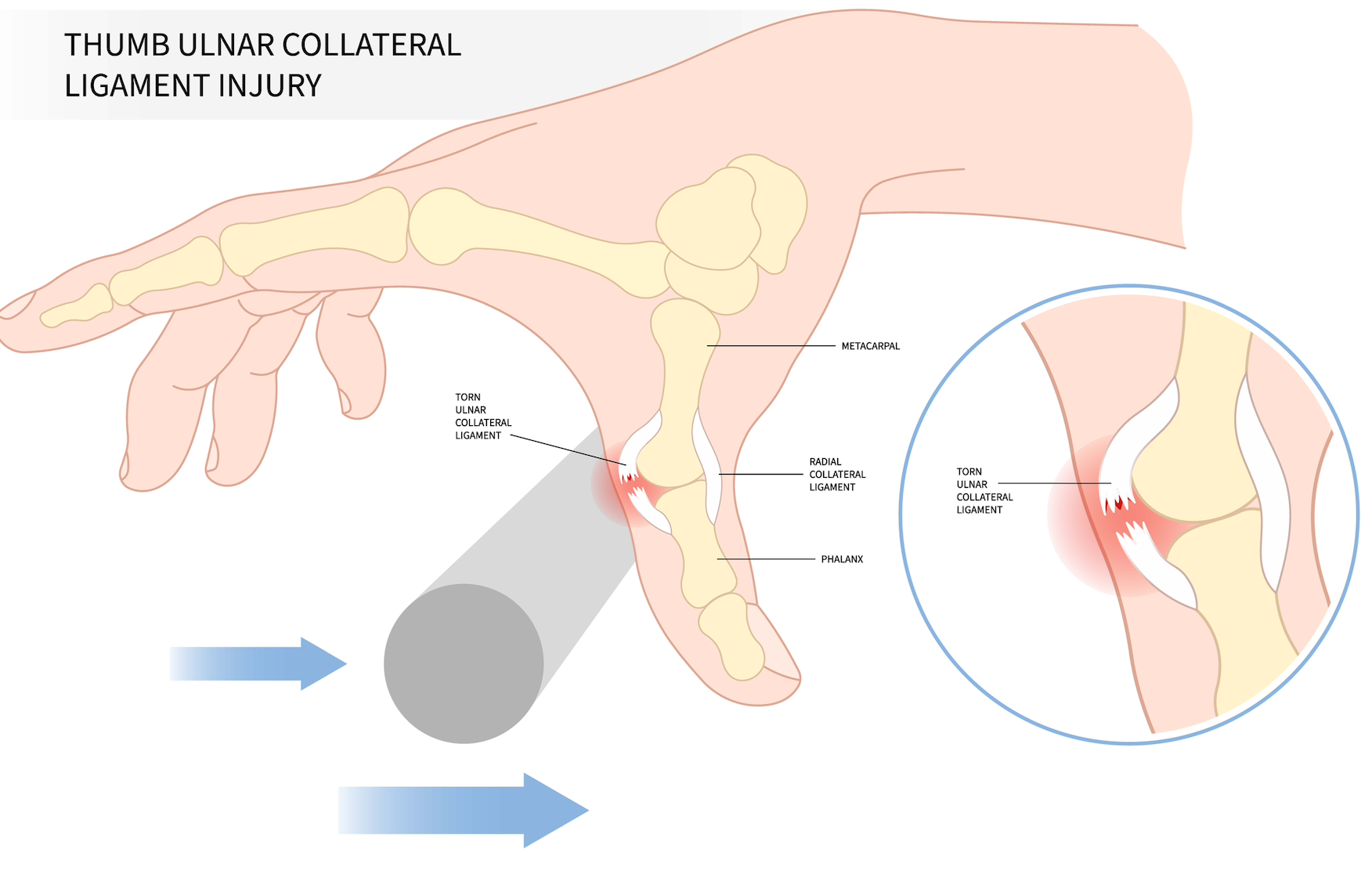
Your thumb's stability at the base joint (metacarpophalangeal or MCP joint) depends on ligaments on either side. The ulnar collateral ligament (UCL) runs along the inner aspect (toward your index finger), while the radial collateral ligament (RCL) runs along the outer aspect.
UCL injuries are approximately ten times more common than RCL injuries. RCL sprains are much less frequent and in most cases heal well with splinting alone.
UCL injuries typically occur when your thumb is forced away from your hand - commonly during football, soccer, or downhill skiing (UCL injuries from skiing are often called "skier's thumb"). Chronic injuries can develop from repeated stress over time.
-
Ligament sprains are classified into three grades:
Grade 1: partial tear with no joint instability
Grade 2: partial tear with some looseness but the joint has a firm stopping point when stressed
Grade 3: complete tear with significant instability - the joint opens more than 30-35 degrees or 10-15 degrees more than your uninjured thumb
-
Symptoms include:
Pain with pinching or gripping activities
Tenderness and swelling at the thumb base
Feeling of weakness when pinching
Joint instability or sense of "giving way"
Occasionally a tender lump near the joint (this can indicate a specific injury pattern requiring surgery)
I'll examine your thumb by stressing the ligament to assess the degree of injury and whether there's a firm endpoint. X-rays are always obtained to check for bone fragments or fractures. MRI scanning may be necessary in some cases to fully characterise the injury.
-
Non-operative management
Grade 1 and 2 injuries typically heal well with immobilisation for 4 - 6 weeks in a specialised thumb splint. Following this, you'll begin grip and pinch strengthening exercises.
Outcomes are excellent with conservative treatment for partial tears - most patients return to sport without residual looseness or functional limitations.
Surgical repair
Grade 3 injuries (complete tears with significant instability) generally require surgical repair. Some UCL injuries develop a specific complication where the torn ligament folds back on itself and becomes trapped outside the joint by overlying tissue - this prevents natural healing and necessitates surgery.
The procedure involves reattaching the ligament to bone using sutures, anchors, or occasionally a small screw if a bone fragment is present. The surrounding tissues are also repaired. Your thumb will be immobilised post-operatively while allowing your thumb tip (interphalangeal) joint to move.
Reconstruction
Chronic injuries (more than 4 - 8 weeks old) where the ligament tissue has become incompetent may require reconstruction using a tendon graft. This involves weaving a donor tendon (typically palmaris from your wrist) through bone tunnels to recreate the ligament's function. Synthetic tape may be used to augment the reconstruction (an internal brace).
Fusion
In cases where arthritis has developed from chronic instability, or when previous repairs have failed, fusing the thumb MCP joint may be recommended. The joint is positioned at 15 degrees of flexion - this maintains excellent pinch and grip function while eliminating pain and instability.
-
Most patients achieve good outcomes with appropriate treatment. Following surgery, expect rehabilitation to include progressive range of motion exercises and strengthening.
Potential complications:
Stiffness: both the MCP joint and thumb tip joint can become stiff, though therapy helps minimise this.
Persistent instability: approximately 15% of grade 3 injuries treated non-operatively develop ongoing instability requiring reconstruction.
Numbness: temporary numbness near the incision from sensory nerve irritation can occur but typically resolves with observation.
Thumb ligament injuries require accurate diagnosis and appropriate treatment for optimal outcomes. If you've injured your thumb and are experiencing instability or difficulty with pinching, please seek prompt medical assessment.