
De Quervain's tenosynovitis
Understanding the condition
De Quervain's tenosynovitis causes discomfort along the radial (thumb) side of your wrist, where specific tendons pass through a confined compartment. The condition involves inflammation and thickening of this tunnel, restricting smooth tendon gliding.
Why it develops
In many instances, De Quervain's appears spontaneously without identifiable triggers. New mothers experience this condition commonly - whether from hormonal fluctuations following childbirth or from repetitive lifting mechanics remains unclear.
While occupational factors show limited causal connection, symptoms frequently worsen with hand-intensive activities across various settings - professional tasks, domestic duties, recreational pursuits, or athletic endeavours.
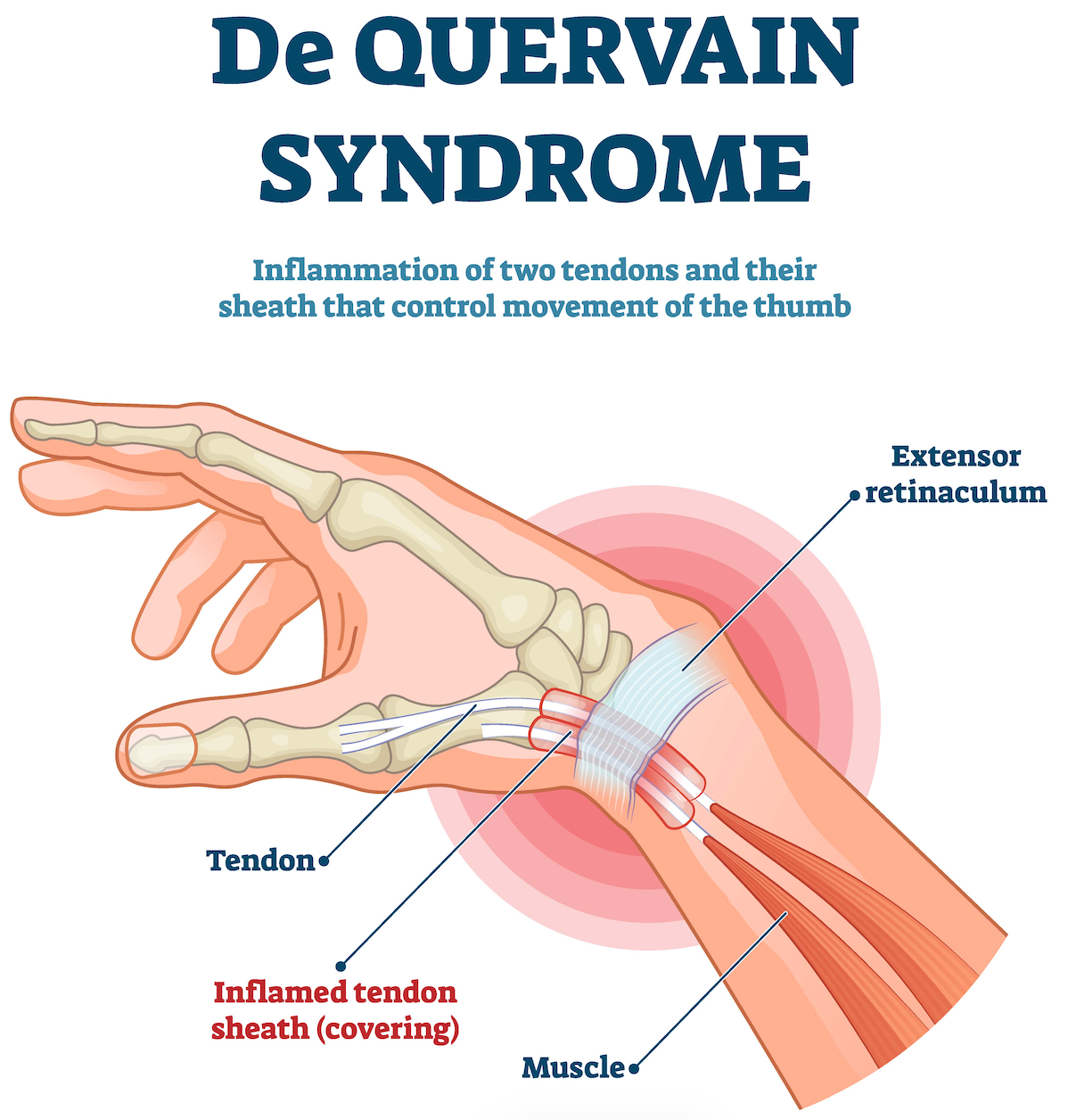
-
Aching along your wrist's thumb border
Pain intensifies with thumb extension (hitchhiker gesture) or when using scissors
Localised tenderness upon palpation
Visible swelling compared to your opposite wrist
Occasional catching or popping sensation with thumb movement
-
Though De Quervain's isn't medically concerning, it can significantly impact daily function and cause considerable discomfort. Milder presentations sometimes improve spontaneously over several weeks.
Rest and activity adjustment
Where practical, minimising aggravating movements allows natural resolution.
Immobilisation
A thumb-spica splint (available from hand therapy or chemists) provides symptom relief by restricting both wrist and thumb motion. Effective bracing must stabilise the thumb - wrist-only supports won't adequately rest the affected tendons.
Corticosteroid injection
Injections achieve pain resolution in roughly 70% of patients. Adverse effects occur rarely but may include localised skin atrophy or pigmentation changes at the injection site.
-
When conservative measures fail, surgery offers definitive treatment. The procedure can be done under local anaesthesia (infiltrated at the operative site), regional nerve blockade (armpit injection numbing your arm), or general anaesthesia.
Through a small incision (oriented along the wrist), I carefully preserve superficial nerve branches while dividing the tunnel's constraining roof.
Pain relief typically occurs promptly. Your incision may remain sensitive and appear prominent for some weeks. Because nerve branches require gentle retraction during surgery, temporary numbness affecting your thumb or hand's dorsal surface occasionally develops but resolves. Standard surgical risks including infection (under 1% probability) or stiffness apply.